



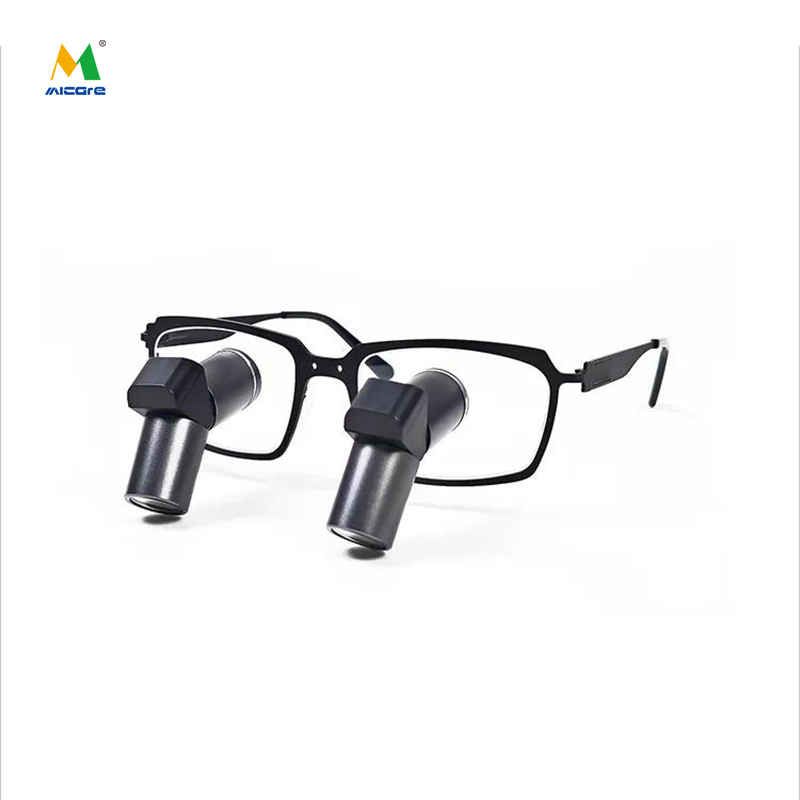
An indispensable part of modern surgery and medical diagnosis, medical loupes have made a major impact on how physicians are able to view the subtleties of the human body during an operation or procedure. Neurosurgery and ophthalmology are classic examples among all specialties, but dentistry and emergency medicine have also seen significant improvements with the use of optical devices that can help with precise detailing. Selecting the optimum medical loupes can be complicated with several choices; this article can guide you on this journey.
Understanding Magnification and Its Impact
Magnification is probably the most important, and most misunderstood, feature of a medical loupe system. Loupes range in magnification of from 2.5 up to 6.0, though this magnification guideline may not necessarily mean it's appropriate to be tied to one value in order to maximize functionality of particular tasks. Lower magnifications (2.5-3.5 magnifications) provide a broader field and depth of field which will be appropriate for general surgery, wound repair and procedures requiring high spatial orientation. At higher magnifications (4.0 to 6.0 magnification), more details are visible and would be suitable for microsurgical tasks like nerve repair, vessel anastomosis and ophthalmic procedures.
Also very true that many of the advertised magnifications do not actually match optical realism. Independent optical testing of Galilean loupe systems has been shown to vary up to 1 magnifying power. A loupe marked as 2.5 was measured to be 2.0 in magnification and another was marked as 3.2 was tested to 3.1 in magnification. Thus, given that it may be misleading to claim to have a higher magnification, try to do some magnification testing in your clinical environment before buying, if possible.
3.5 magnifications have proven to be beneficial in a wide array of clinical applications by allowing both adequate detail and sufficient field of view. In a study on the accuracy of oral mucosal lesion diagnosis, 3.5 magnification was found to be of an appropriate parameter for the diagnostic success.
Galilean vs. Keplerian Optical Systems
The Type of loupe system (Galilean or Keplerian) also affects the size, cost and performance. Galilean-type systems, with their basic lens sets, are simpler and more affordable and cheaper, and they have a very good wide field of vision at lower magnifications (e.g. 2.5 to 3.5X), and the resulting loupe system is lighter, although the lenses can have some optical distortions at the extreme edges of the field and less image clarity at greater magnifications.
The more complex prisms of a Kepler type loupe system allow for a higher magnification (e.g. 3.5X to 6.0X) but at a higher price point and the system itself is bulkier. This type of system however offers clearer magnification at higher magnifications and greater minimal distortions than Galilean type loupes as magnification accuracy remains fairly consistent at various magnifications unlike those in a Galilean setup.
As a result then the ideal loupe depends on what sort of work is going to be carried out. Clinicians who primarily do work that requires lower magnification (up to 3.5X) would benefit from Galilean type loupes, while clinicians who frequently use 4.0 magnification or higher, especially in micro surgery, would benefit from Kepler type loupes.
Working Distance and Ergonomics
The second important component to holding it comfortable and functioning well in clinic is to pay attention to the working distance. A typical working distance ranges anywhere from 200mm to 420mm. Most surgeons will be in the 300mm to 420mm range.
Working with a longer working distance, you'll have greater mobility to get into a more upright position therefore creating less strain in your neck over a lengthier case. For this to remain effective the loupes will have to accommodate this for a greater range of depth of field. For all individuals, working height preference, stature and type of work being done determine their needed working distances.
Longer working distances generally are warranted when the size is greater to minimize flexion of the neck. Your loupe package will fit around you, allowing you to not bend your neck. Some loupe systems you may additionally include adjustable working distances creating for the finest option as a result of work selection.
Mounting Options and Customization
There are several different mounting methods possible. There are a variety of ways loupes mount in, here's what each method offers and what it costs. These are lightweight, stable and hands-free, and attach directly to your prescription spectacle frames . These are the most popular for surgeons who wear corrective lenses and want something permanent and convenient.
The loupe module is on the front of the spectacle frame attached to a hinge that lets the module be folded up and out of the way when not in use. This allows procedures to be performed in a way that allows for intermittent magnification and communication to be used between the patient and staff without loupes being removed.
Headband-mounted loupes are the most adjustable and the positioning can be adjusted without eyewear. They are highly stable, but not as widely used in surgical environments because they are bulky and require extra support.
When selecting mounting, take into account, among other things, the prescription needs, the ease of adjustment and the need to have integrated illumination. LED lighting is key to many modern loupe systems, as it provides consistent, shadow-free illumination at the surgical site that is essential for procedures that require that kind of lighting.
Nanchang Micare Medical Equipment Co., Ltd. is a high-tech enterprise with innovative development and manufacturing of medical lights. Although Micare's main product line is surgical lighting solutions, it also provides medical loupes and accessories for complete operating room lighting solutions. Contact us a call and one of the team at Micare can help with a personalized consultation for your loupe requirements and advice regarding lighting.