



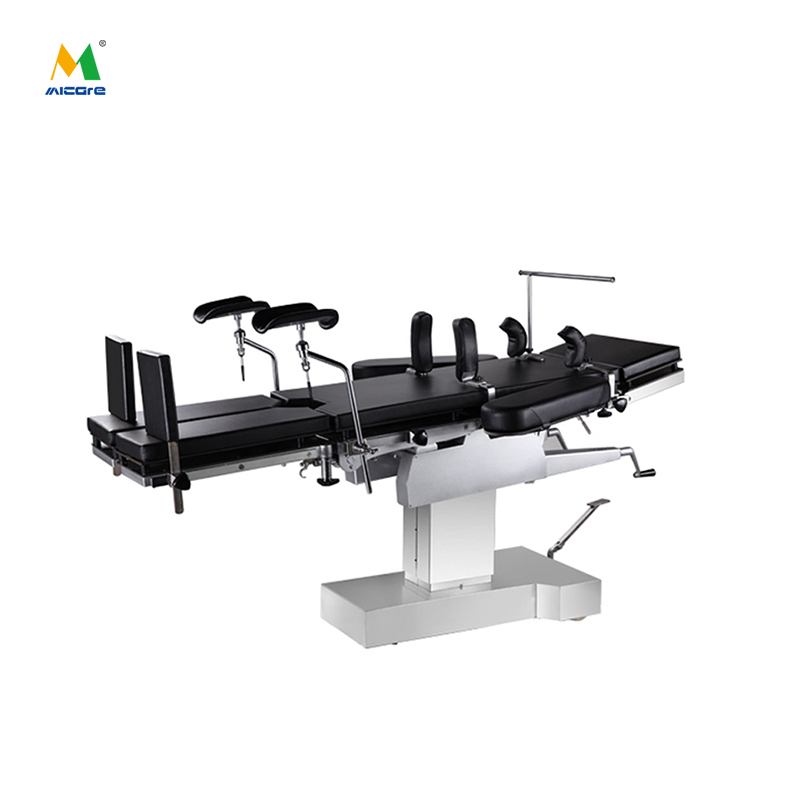
One of the most important decisions to make when setting up a modern operating room is selecting the right surgical table. It serves as the foundational base for all procedures and plays a crucial role in the accuracy of operations, patient safety, and overall workflow efficiency. A central one of the questions that always presents itself for the surgical teams and hospital procurement specialists is whether to invest in an electric surgical table or a hydraulic table? It's important to differentiate between the two technologies and choose the one that will meet the long-term budget and clinical requirements of your hospital.
The Core Technology: Motors vs. Fluid Pressure
The main distinction between electric and hydraulic surgical tables is the way they provide the power for movement and positioning. Electric surgical tables feature electromechanical actuators which move the table up and down, tilt it, and adjust other positions thanks to motors and are usually operated by a handheld remote control or a handle panel located on the base of the table. This control system provides accurate one-touch operation. Hydraulic tables, on the other hand, work based on fluid pressures. Usually, adjustments are performed using a foot pump or manually by rotating a hand crank which needs human power to move it to the desired position. Both can be important, but they have very different working principles which cause performance and user experience differences.
Precision and Control in the Operating Field
Precision is key in modern-day surgery. Pointing accuracy of up to 0.1-0.5mm is the specialty of electric systems and many may have more than 20 programmable preset positioning for frequently used surgical operations. This enables surgeons to quickly switch to a procedure they prefer to utilize the table in the way they like, and saves them a lot of time when handing off cases. Standard hydraulic tables typically offer less control and are more complicated to adjust during the procedure, though the advanced electro-hydraulic platform does provide smooth and precise control. An electric table's intuitive, easy control puts the surgeon's focus on the patient instead of the mechanics of positioning.
Total Cost of Ownership and Long-Term Value
Although the up-front cost of a table is an important consideration, the total cost of ownership over the course of a table's life is a better indicator. The price of electric tables is 50-70% higher than hydraulic tables. There is, however, a trade off in that the initial investment may be more expensive, but the long-term savings are reduced. Electric systems tend to be 75-80% energy efficient, and only need 1-2% of the cost of the system for maintenance through oil changes and replacing seals, etc., while hydraulic systems can cost 3-5% annually because of oil leakage, seal replacement, etc. This means that the total cost of ownership of an electric table over 10 years may be 60-70% of the cost of ownership of a hydraulic table, making the electric table a potentially more economical option in the long run. It's an important factor for a hospital that is planning a budget.
A Practical Solution: The Electro-Hydraulic Hybrid
Fortunately, for many surgery applications, it is not an either/or proposition, it is a combination of both technologies. Electro-hydraulic tables, such as those provided by Nanchang Micare, such as ET300C and ET500T series, combine the advantages of an electric pump and hydraulic cylinder, providing the best of both worlds. This design combines the smooth, powerful and quiet positioning of a hydraulic system with ease and precision of electric control. In addition, the ET500T features a sturdy construction, a max patient weight of 250 kg and a longitudinal slide of up to 345 mm which provides optimum access to the C-arm, making it an adaptable and dependable solution for all surgical departments. This blend of the two can be the "sweet spot" for hospitals that want advanced functionality but don't want to sacrifice reliability or value.
In the end, it will come down to your surgical volume, specialty mix and budget. In a low-cost environment, hydraulic tables might be good enough, but in a high-acuity, multi-specialty OR, electric or electro-hydraulic tables offer greater precision, efficiency and value. Investing in the right table is investing in better surgical outcomes and an efficient department.