
Nobody looks at an electricity bill and blames the operating room. But they probably should.
ORs consume three to six times more power than a standard clinical space. A surgical lighting system alone eats up 15–20% of that — and that's before you account for the air conditioning fighting all the waste heat. If your hospital operating lights still run on halogen, you're not looking at a line item. You're looking at a slow leak.
I've walked through facilities where the procurement team had no idea their OT lights were quietly burning through budget every single day. It's not negligence. It's just that nobody connects the dots between a light fixture and the utility bill unless someone makes the case. So here it is.
Halogen Costs More Than the Sticker Price
A dual-head halogen surgical light draws 300 to 500 watts. That's the direct consumption. Then the bulbs go.
Halogen bulbs are rated for 1,000 to 2,000 hours. In a busy department that translates to replacements every few months. Each swap means calling maintenance, sterilising the fixture, and losing at least thirty minutes of room time. That's a recurring operational cost that never shows up on the purchase order — but it shows up every month in the P&L.
And then there's the thing nobody budgets for: heat.
Halogen converts most of its power into infrared, not visible light. All that waste heat dumps straight into the OR. The HVAC system has to work harder to maintain temperature and humidity — add an estimated 15–30% cooling overhead just to offset the lights. Every watt you save at the light head is a watt you don't pay for twice at the chiller.
LED: A Different Kind of Arithmetic
LED surgical lights draw 60–70% less power than equivalent halogen. A modern dual-head system sits between 80 and 150 watts at full output — and here's the part that surprises people: dimming actually cuts consumption. Halogen doesn't do that. It just bleeds the excess as heat.
The lifespan gap is where it gets almost unfair.
A decent LED head is rated for 40,000 to 50,000 hours. At twelve hours a day, that's ten to twelve years before anything needs attention. Halogen bulbs don't just burn out faster — they degrade. Colour temperature shifts warmer as they age, which matters more than it sounds. In surgery, reds and pinks aren't decorative. If a surgeon can't distinguish oxygenated tissue from deoxygenated tissue, the light isn't doing its job.
LEDs hit a CRI above 90 as standard. Better systems push past 95. Halogen sits in the low-to-mid 80s and drifts yellower over time. That's not an opinion. It's measurable — and measurable things matter in an OR.
Then there's the part nobody writes white papers about: cleaning. Halogen fixtures need vents to shed heat, and vents collect dust, lint, and whatever else circulates in an operating theatre. LED heads are sealed. Smooth surfaces, fewer crevices, faster wipe-down between cases. In a high-volume OR, saving ten minutes per turnover adds up to real capacity.
What Actually Matters When You're Buying
Most spec sheets list the same things. The numbers that separate a surgical light you'll still be happy with in five years from one you'll regret usually come down to a handful of details:
Red rendering. CRI is an average. R9 — the red component — is what surgeons actually notice. If R9 isn't above 90, the colour discrimination isn't there. Ask for it. If the supplier hesitates, that's information.
How it handles failure. LED modules will eventually fail. The question is whether one dead pod means replacing the entire head or swapping a single module on-site. If a shadowless operating light needs factory return for a component swap, it's not a 50,000-hour product — it's a product with a 50,000-hour asterisk.
Shadow performance. A true shadowless operating light isn't about cramming more LEDs into the housing. It's about geometry — how the reflectors are arranged, how the beams overlap. Multi-reflector configurations hold intensity when a surgeon's head or hand passes through the field. Single-bank arrays don't. The difference is visible the first time someone leans in.
Whether it speaks the same language as the room. A ceiling mounted surgical light shouldn't be an island. If your OR runs integrated controls, the light needs to accept brightness and colour temperature commands through open protocols — not some proprietary box that locks you into one vendor's ecosystem. Same goes if your setup runs through a medical pendant system with gas and monitor arms. Interoperability isn't a luxury anymore.
You're Buying the Next Decade, Not the Next Quarter
Halogen stuck around for decades because it worked and nobody offered a better option. That changed.
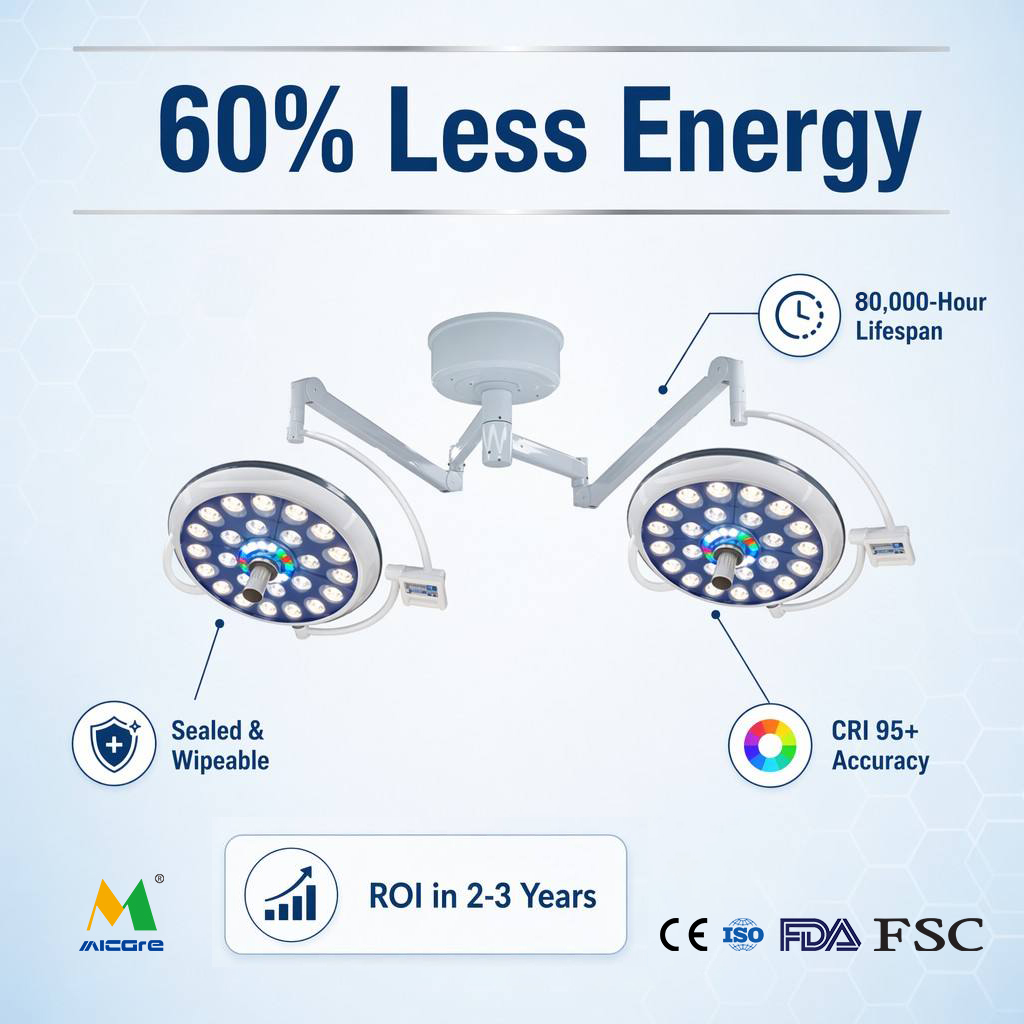
LED surgical lamps now beat halogen on energy, lifespan, colour accuracy, and heat output — all at once. The upfront cost is higher, but you recover it through utility savings and zero bulb maintenance inside two to three years. After that, the arithmetic runs in your favour for another decade.
There aren't many pieces of hospital equipment where the financial case and the clinical case align this cleanly. An LED surgical light saves money, makes surgeons happier, and keeps the OR cooler. If you're the person making the recommendation, that's about as straightforward as capital equipment decisions get.
For more information, please contact us: Nanchang Micare Medical Equipment Co., Ltd.
Contact: Jenny Deng Phone: +(86)18979109197
Email: [email protected]


