
For many dental and surgical professionals, the decision to purchase their first pair of loupes is often driven by a mix of peer recommendations and price comparison. However, treating this investment like a simple gadget purchase is a mistake that can lead to chronic neck pain and eye strain. At Micare, we’ve seen countless practitioners struggle with poorly fitted equipment. To help you avoid these pitfalls, here are five essential things you must know before purchasing your next pair of dental loupes.
1. The "Sweet Spot" of Magnification A common mistake for beginners is assuming that more power is always better. In reality, as magnification increases, your field of view (FOV) shrinks and your depth of field becomes narrower. If you are doing general dentistry or broad surgical exams, starting with 4.0x or 5.0x will likely lead to frustration—you'll spend more time "searching" for the tooth than working on it. For most clinical work, 2.5x to 3.5x is the "sweet spot." It provides enough detail for margins and fissures while allowing you to see the entire arch without moving your head constantly.
2. Optical Clarity vs. Simple Enlargement There is a massive difference between making an image "bigger" and making it "sharper." Cheap loupes often use simple glass that causes chromatic aberration—that annoying "rainbow fringe" you see around the edges of a tooth. This distortion forces your brain to work harder to interpret the image, leading to headaches by mid-afternoon. Professional-grade loupes, like those from Micare, use high-resolution achromatic optics. This ensures that the image is crisp from edge to edge, allowing you to differentiate between a stained fissure and actual decay with absolute confidence.
3. The Ergonomics of the Declination Angle This is perhaps the most critical factor for your long-term health. The declination angle is the steepness at which the loupes look downward. If the angle is too shallow, you will naturally tilt your head forward to see the patient, leading to what is known as "Surgical Neck" or Musculoskeletal Disorders (MSDs). Your loupes should allow you to look down with your eyes while keeping your neck in a neutral, upright position. At Micare, we prioritize customizable declination angles because we know that the loupes must fit your posture, not the other way around.
4. Weight and the "Balance Ratio" While many manufacturers focus solely on "total weight," the real secret is balance. A front-heavy pair of loupes will put immense pressure on the bridge of your nose and cause the frames to slip when you sweat. You want a system that distributes the weight toward your temples and the back of your head. Whether you choose a TTL (Through-The-Lens) or a Flip-Up design, the center of gravity should be as close to your face as possible to reduce the leverage effect on your neck muscles.
5. B2B Support and Longevity When buying for a clinic or a hospital, you aren't just buying a product; you’re buying a partnership. How easy is it to replace a screw? Can the working distance be recalibrated? Micare specializes in providing durable, medical-grade solutions that withstand the rigors of daily sterilization. We understand that in a professional setting, equipment downtime is lost revenue.
Conclusion: Choosing dental loupes is an investment in your career longevity. By focusing on these five pillars—magnification, clarity, ergonomics, balance, and support—you ensure that your vision remains sharp and your body remains healthy for years to come.
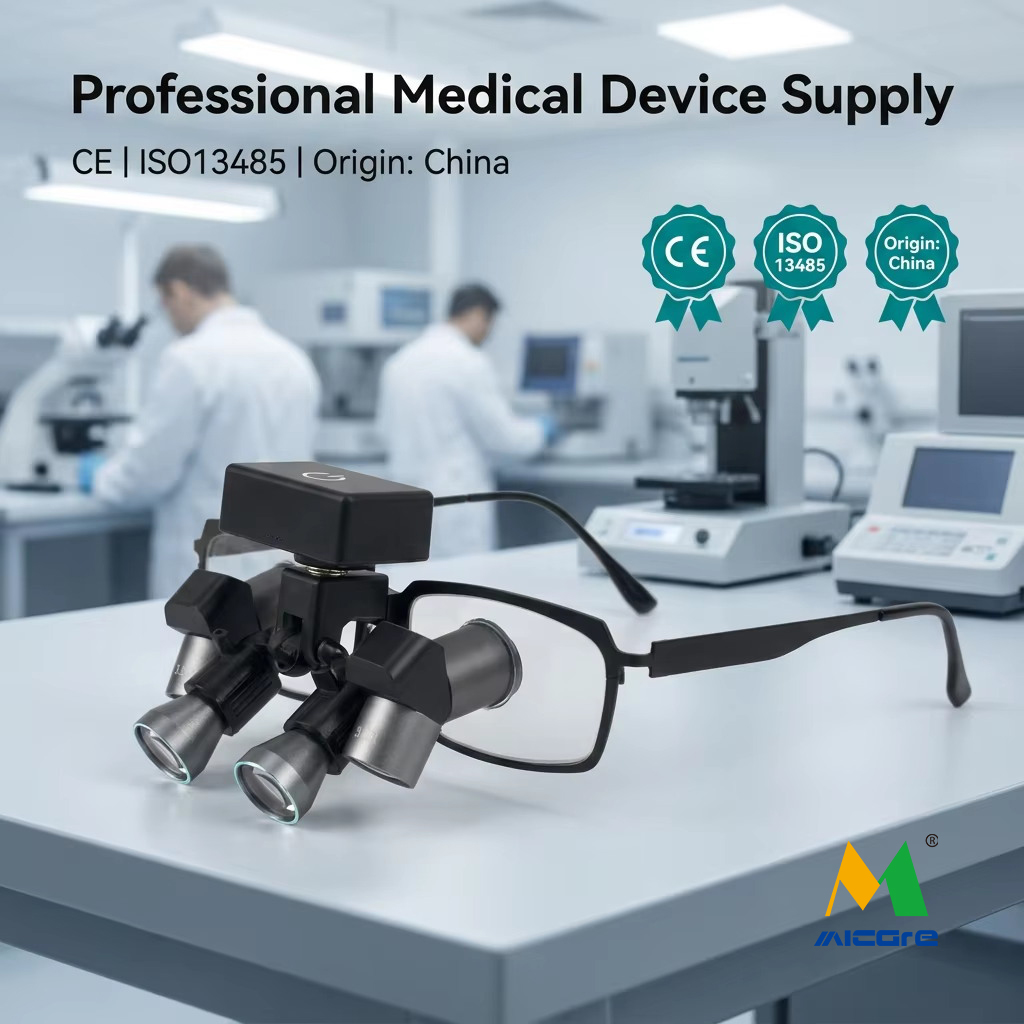
For more information, please contact us: Nanchang Micare Medical Equipment Co., Ltd.
Contact: Jenny Deng Phone: +(86)18979109197
Email: [email protected]


