
Most clinics get this wrong in the same direction. They size the panel count to the room rather than to the film, order the largest unit that fits, and then read one film at a time on a surface three times wider than the work.
The arithmetic is short, and it does not start with a catalogue. It starts with the largest film in the building and the number of people who need to see it at once.
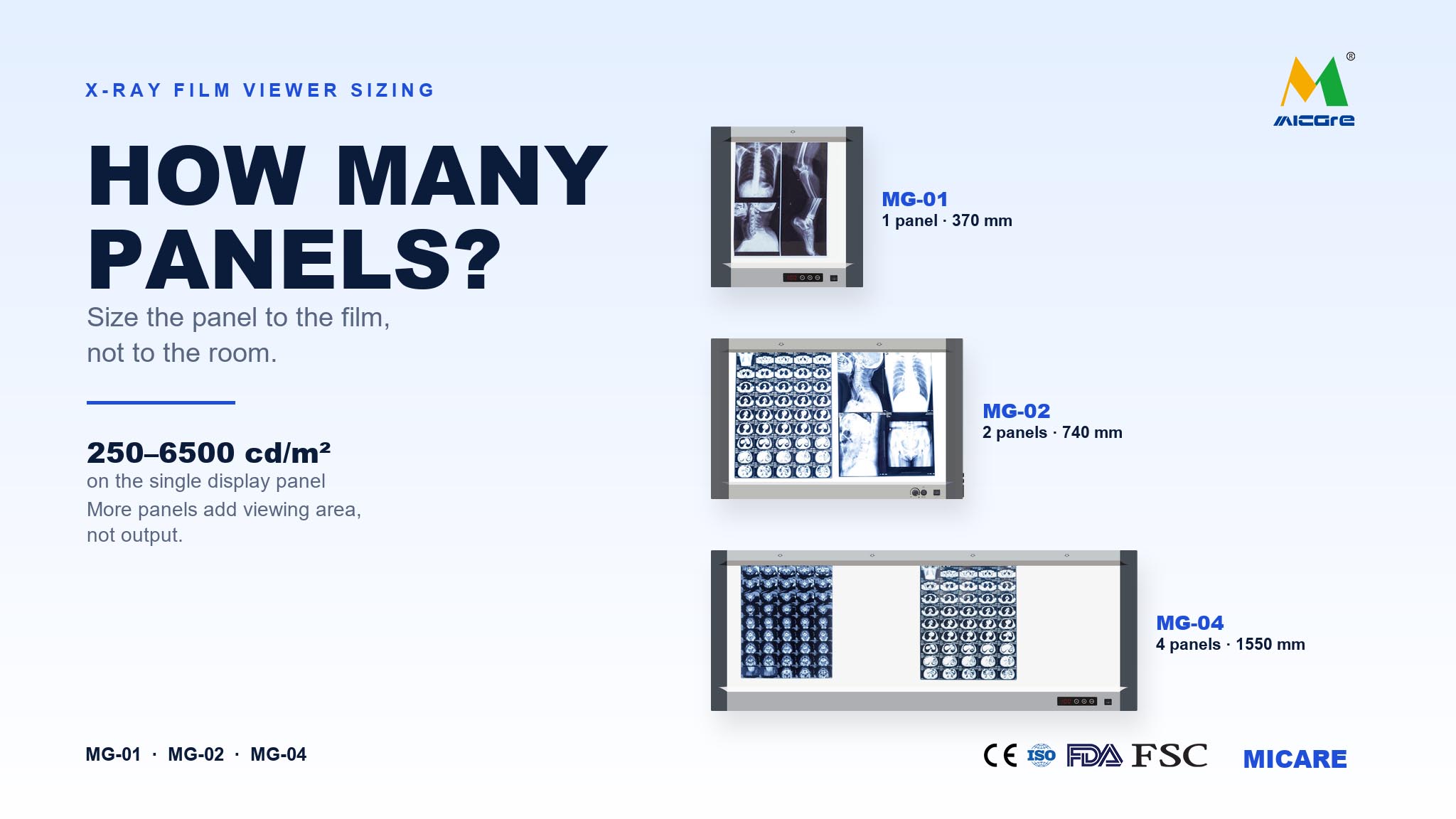
Every datasheet in this range prints two sizes, and most buyers read only the first. The screen is the lit area the film rests against. The outer frame is what has to fit on the wall or the bench. On the single panel the difference is 117 mm of width and 105 mm of height: a 370 × 440 mm screen inside a 487 × 545 mm frame, 24 mm deep. On the double, 740 × 440 mm inside 857 × 545 mm. On the quadruple, 1,550 × 440 mm inside 1,610 × 545 mm.
If you size from the screen and order from the frame, one of two things happens: the unit will not fit, or you buy a smaller screen than the wall could have carried.
The trap is in the single panel. Two versions exist and they are not interchangeable: the display version at 370 × 440 mm inside 487 × 545 mm, specified above 10,000 K with a 250–6,500 cd/m² range, and the knob version at 360 × 440 mm inside 470 × 545 mm, specified above 8,600 K. Ten millimetres of screen, seventeen of frame, and a different control surface. Check which one your quotation refers to before comparing it to anything else on this page.
The largest film. Film formats are standard, so this is a measurement you already have. A 35 × 43 cm chest or abdominal film needs a screen that clears 350 × 430 mm — the 370 × 440 mm panel does, with a margin on all four sides. If your largest format is a 30 × 40 cm film or a panoramic dental image, the same panel holds it with more room to spare.
How many films at once. This is the only input that changes panel count, and it is a question about workflow, not about light. Count the reading positions that have to be occupied simultaneously: one clinician reading alone is one; an antero-posterior and a lateral view compared by the same person is still one position but two films; two people reading different films side by side is two positions.
Where it hangs. Wall run, bench depth, and whether the position has to move. A double panel needs a clear wall run longer than 857 mm; a quadruple, longer than 1,610 mm. A single panel on a floor stand needs its stand footprint plus the space to walk past it.
Put together, those three answers produce the count, and the answer is usually smaller than the room suggests.
One panel — one reader, one film, one position. The single panel answers a consulting room where the doctor reads alone and the print is a single sheet. This is the correct choice in more clinics than buy it, because the alternative is bought for the day two films arrive together.
Two panels — comparison. Antero-posterior next to lateral, or this week's film next to last year's, without moving either. The MG-02X is the knob-controlled double: a 740 × 440 mm viewport — two 370 mm panel widths with no seam between them — inside an 857 × 545 mm frame. For most small hospitals and orthopaedic clinics this is the configuration the arithmetic lands on, because comparison is the majority of what they read.
Four panels — throughput. Not comparison, and not brightness: four panels exist so that a batch can be laid out and read in sequence without filing between films. Orthopaedic pre-operative work, a fracture clinic running behind schedule, a teaching session where four films are discussed in order. The MG-04X provides a 1,550 × 440 mm viewport inside 1,610 × 545 mm, on the same construction as the double. If your day never has four films out at once, the fourth panel is wall space you paid for and never use.
It is worth saying plainly: a quadruple panel is not two doubles bolted together. It is one continuous lit surface with one frame and one supply, which is why it is deeper — 41.6 mm against 24 mm — and why it needs a different mounting decision.
This is the assumption that produces the wrong order. Adding panels adds viewing area; it does not raise output, because the lit construction and the supply are shared across the range rather than uprated with each panel.
The single display panel is specified from 250 to 6,500 cd/m² on a continuous PWM dimmer, 1% to 100%, above 10,000 K. That is a working range for general radiography, and it is set by the film in front of you rather than by the number of panels beside it. Dense film needs the top of the range; thin soft-tissue film reads better lower down, where a bright panel washes out the density differences you are trying to see.
Two more numbers decide whether a panel is readable across its whole surface. Even illumination above 0.9 means the corners hold up against the centre. An optical scattering coefficient above 0.7 means the light is diffused rather than projected, so the LED array does not read through a thin film as a grid of points. Neither figure improves when you add a second panel.
A film viewer is switched on at the start of a clinic day and often left on. The single panel is rated for more than 24 hours of continuous operation, lights within 10 seconds of switch-on, and reaches luminance stability within 15 minutes. Noise stays below 40 dB, which matters where a clinician is dictating next to it. The outer surface stays below 60 °C after an hour of running, so a film pressed against it does not become a handling problem. Supply is 12 V DC with 30–100 kHz regulation.
These are the figures that decide whether the unit survives five years in a room where nobody thinks about it, and they are the ones least often compared.
A wall-mounted panel wants a wall run longer than its frame, and a position that is not opposite a window. Daylight falling across a lit panel flattens exactly the density differences the panel exists to show, and no dimmer setting fixes it.
A floor-standing panel is the answer in three situations: the wall is occupied or unsuitable, the reading position has to move, or the building is leased and nobody wants to drill. At 24 mm deep it can sit beside a desk rather than replace part of it — but check the floor area it takes when the stand is extended, and keep it clear of the route between door and desk.
Diagnostic monitors are a separate problem. A film viewer beside a calibrated monitor should not throw light across the screen; position them so the panel is behind or to the side of the person reading, not facing the monitor.
Send three things and the configuration follows without a meeting: the largest film format you handle, how many films are on the panel at the same time, and whether it hangs on a wall or stands on the floor.
What we will not do is recommend the largest panel because it is the largest panel. For most clinics the answer is the MG-02X; where the arithmetic says one panel, the single; where it says four, the MG-04X. The full range with panel counts and frame sizes side by side is on the MG Series page.
Micare Medical Engineering Team
Does more panels mean brighter? No. Panel count changes how much film you can read at once. The single display panel is specified from 250 to 6,500 cd/m², which is a working range for general radiography; the reason to move to a double or quadruple is comparison and throughput.
What is the difference between screen size and outer size? Screen size is the lit area the film sits against — 370 × 440 mm on the single display panel, 360 × 440 mm on the knob version. Outer size is the physical frame — 487 × 545 × 24 mm and 470 × 545 × 24 mm respectively. Size the screen to your largest film, the frame to your wall or bench.
Can a single panel read films larger than 35 × 43 cm? Not without overhang. A 35 × 43 cm film fits the 370 × 440 mm screen with a margin on all four sides; a larger format will hang past the lit area, and the edges of the film will be read against the frame rather than the light.
Can one viewer serve two reading positions? Only if they read at different times. A wall-mounted panel is fixed where it is installed; a floor-standing one can be repositioned between sessions, not between two people reading simultaneously.
Why does the quadruple need more wall depth? It is 41.6 mm deep against 24 mm on the double and single panels, because it carries one continuous surface and one supply across four panel widths. Check the frame dimension, not the screen dimension, against the wall you have.
For more information, please contact us: Nanchang Micare Medical Equipment Co., Ltd.
Contact: Jenny Deng Phone: +(86)18979109197
Email: [email protected]


