



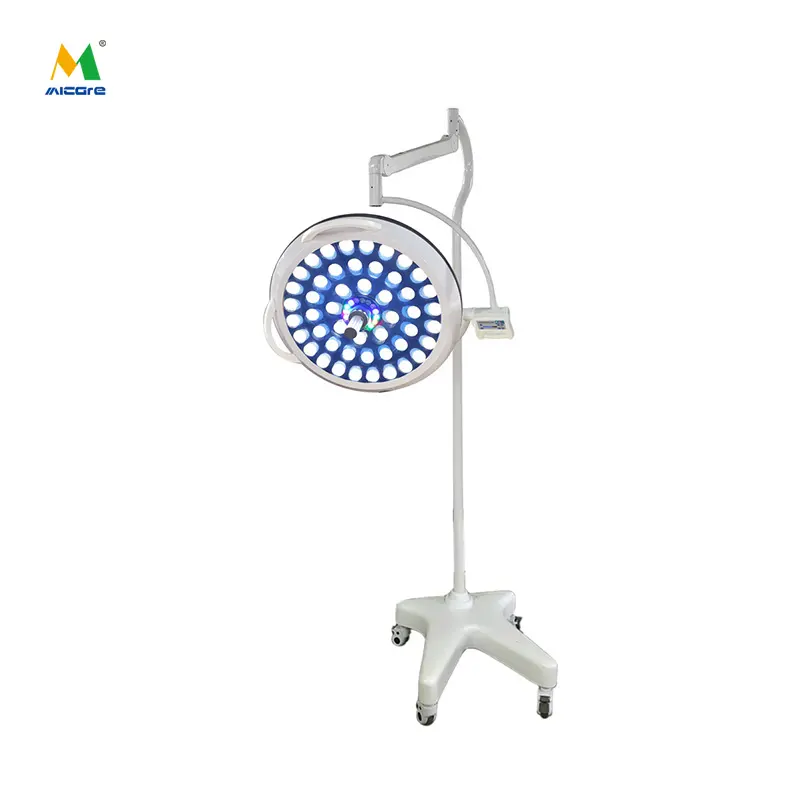
The Halogen lamps were long regarded as the dominant type of light source in medical equipment such as from surgical headlights and endoscopes, from medical light exam lamps to surgery lights but those lights were replaced by LED technology with a speed of lightning. Though these technologies are both common in hospitals and equipment nowadays, awareness of the advantages of LED lamps vs. Halogen lamps is still required when purchasing medical supplies. So let us break down into details for Halogen lamps vs. LED lamps.
Light Quality and Visual Accuracy
When details require more clarity at a microscopic level, the LED light used in a medical instrument could certainly give better. Light intensity and quality influence vision in examinations, not just the way that the light shines or reflects off it. However Halogen light will produce the yellow hue lighting that will make a person skin look much fairer, damaging color vision as it doesn’t fit the normal natural day light color as well.
High-quality LEDs create accurate color rendering index and a high intensity of light.
LEDs may mimic natural daylight and that may create more of clarity and distinction on the body. You are provided with the distinction of redness over other body’s color which will serve to the accuracy of your analysis or Identification. A constant glow from LEDs will provide you with the perception of seeing with the accurate color at any point of usage and when Halogen light dims, there always color fluctuation which can be confusing.
Heat Generation and Thermal Safety
As it was said prior in the article, Heat generation from light is indeed an issue. In any case Halogen light poses an obvious issues to healthcare workers at an operating room that, because of its high thermal radiation, at long operations can turn it to a sauna in there, thus posing not only a risk for patient tissue to dehydrate, and burns the them, and a patient but also of providing the healthcare staff the least appealing conditions to carry out sensitive procedures. Halogen can damage retinal pigment epithelial cells and induce DNA mutation or apoptosis. LED technology emits such little Heat that it not only provides a safer environment in and in and an OR but will increase patient-health as it prevents further drying and burn, that can occur in certain surgeries as in ophthalmic procedure.
Energy Efficiency and Operating Costs
Compare LED light fixture vs Halogen light fixture. There is some vast different in energy usage of these two technologies, an LED has usage 70% less energy than Halogen with equal lumen output; Also LED light bulb don’t emit a large amount of heat on an atmosphere like a Halogen light does. The fact that it doesn’t generate more heat reduces your operating expenses by way of reduced air-conditioning cost.
Moreover, you save additional energy on Halogen as these light devices usually require extra aircon as the devices generates a good amount of heat during operation. Hence reducing the costs of aircon and an already busy clinic and hospitals operating costs.
You also save cost that you'll normally spend on a fan, or other auxiliary devices you'll normally use on your equipment when powered with Halogen. An Environmentally oriented hospital like this will embrace all ways of minimizing consumption such as what ISO-14001 sets out to achieve, thus using LED can be a great contribution for those hospitals who aspire for the ISO-14001 certification or the E.H standard (Environmental Hospital).
Lifespan, Maintenance, and Long-Term Value
The cost effectiveness in having a light source for equipment is determined by a bulb’s lifespan. Some procedures can be put on hold or even prolonged if a light fixture dies unexpectedly. Typically, Halogen bulbs have a lifespan of roughly 1,000 to 2,000hours of use. By contrast, a LED lamp can provide up to 40,000 to 50,000 hours of utilization or in certain instances, even more. With a limited life of 1,000hours, these Halogen devices may even not last a year; especially where usage is on an as needed basis and this requires periodic change of these bulbs and adding on maintenance expenses that is an extra concern in such setting, so LED which can light for morethan20 years(at the minimum use condition mentioned above) is more cost effective for use on medical equipment at some cost although may be initially high, the savings it offers are massive in total cost of ownership (TCO) in the long-term of cost of energy plus bulb replacement. LED technology leads to increased efficiency, reliability and significantly reduced operating costs – both immediately and in the long run. If we put in summary “better light, better service for the patient & safer workspace” – than L.E.D is the answer for the modern medical field.
So, we will encourage you to look forward in the evolution of LEDs and make purchase for them to prevent yourself on having unnecessary expenses. Make sure to contact and find an excellent innovative medical equipment manufacture such as those at nanchangmicare.net in order to see what they have and compare their prices when it comes to exam lights, operating lights and many others. Let us know your visit was inspired by this review for a better lighting solution! Our team will greatly ensure your needs for excellence.