



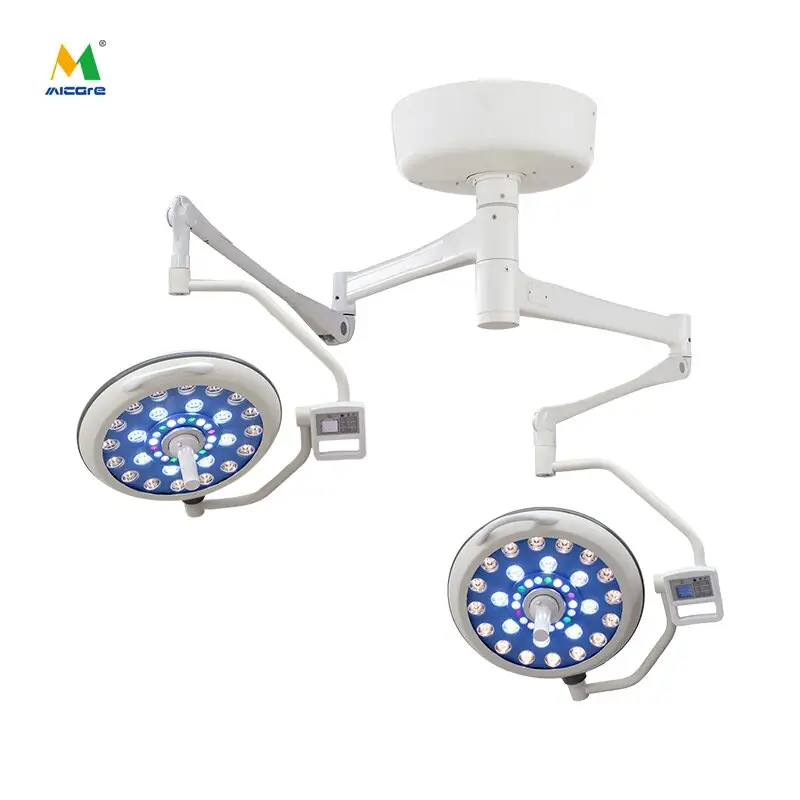
Enter the operating room of a hospital today, and you are likely greeted with a number of high-powered, same-colored, uniformly spread lights suspended from the ceiling. These lights shine brightly and allow the medical personnel to easily view the surgical area. A surgical "shadowless" lamp does just what it states, by not creating shadows. The use of special optics engineering creates a virtually shadowless light, or a shadow that is so minimal that it is almost invisible to the surgeon's eye. Understanding these surgical lights and how they function helps medical personnel become more knowledgeable and thus purchase the most appropriate surgical lights. Nanchang Micare Medical Equipment Co., Ltd. is an innovative high-tech enterprise that primarily deals in the development and manufacturing of medical lighting and equipment, with specialization in medical examination light, medical cold light source and operating shadowless light. Here, technology of surgical shadowless lamp is clearly discussed.
The Principle of Multiple Light Sources
The key element in making shadowless lights operate is that they use a multitude of lights, placed at different angles. When using a single light source, a bright, single shadow will be cast by any given object. Adding a second light from a different direction, however, causes the first shadow to become partially illuminated. If a third, fourth or even dozens of light sources are arranged in myriad angles around the surgical area, the shadows that they create will then also be illuminated by the other light sources and they disappear. Within a surgical shadowless lamp, dozens of separate LED chips or halogen bulbs are positioned in geometric patterns or concentric circles. Each individual light source will cast its own individual shadow, but the other light sources in the surgical light are shining down from so many different angles that they always succeed in illuminating any shadows. At the heart of any shadowless light design, there is a multi source. Micare's advanced engineered shadowless lighting delivers an unobscured surgical field.
The Role of Reflectors and Optical Lenses
However, a multitude of light sources alone does not create a shadowless light. Light tends to spread wildly and would thus fail to produce adequate, consistent light. To remedy this, reflectors and optical lenses play an indispensable role in designing the best surgical lights. Surgical LEDs or bulbs are coupled with a specially engineered smooth reflector, usually a split hemisphere or parabolic curve. This reflector ensures that the light is not lost to the side or back but is directed to the surgical site. The multiple lens optical system is placed above the LEDs to focus and shape the beam. Light is converged on the same point of focus by the multiple lenses. Other high-tech designs such as multifaceted reflectors, offered by Micare, further reduce shadows by dispersing and combining the light beams.
Achieving Deep-Cavity Illumination
The deepest parts of the abdomen, a human skull, or a human joint is often difficult to adequately illuminate during surgery. The regular light can not always reach into the depth of the cavity without its view being obstructed by the doctor's head, hands or medical tools. The two mechanisms which allows shadowless surgical lamps to illuminate the deepest cavities, is placing the multitude of lights on high angles and on oblique relative to the area to be illuminated. Where one light source might be blocked by a doctor or tool, the other will not be. Many of today's advanced surgical and medical cold light sources are designed with LED heads, whereby the light source bulbs or chips are placed around the periphery, or an adjustable focal point which provides ideal depth of illumination. A quality surgical lamp can provide illumination to the deepest of cavities.
Color Temperature and Shadow Dilution Explained
Color temperature (in Kelvins) and shadow dilution are two technical terms that are frequently heard when talking about shadowless lighting. Colour temperature will affect the colour rendition of natural tissues. For surgery (such as daylight), the most optimal range is 4000K - 5000K. Quality LED surgical lights will have a consistent cool neutral white light which older halogen lights will tend to be warmer and yellowish (3200K–3800K). Micare's LED shadowless lamps provide accurate colour temperature, high Colour Rendering Index (CRI>90), for accurate tissue differentiation. Shadow dilution" is the capacity of the lamp to reduce darkness of shadows. Typical measure is the “shadow dilution rate” and the best lights have a rate of 90% or more. This means not only that even if the light beam is obstructed, the general light will remain more or less bright in the surgical field, but also that the light will be clear, and not glaring into the eyes of the surgeon and other people in the vicinity. Modern LED shadowless lamps also provide advanced electronics which enable dimming without altering the colour temperature, providing complete control for surgeons.
Conclusion
A surgical shadowless lamp is actually a lamp that has been engineered with multiple light sources, precision reflectors, optical lenses and intelligent engineering to generate a deep cavity surgical lamp that has minimal visible shadows. It has come a long way from the first single bulb technology to today's sophisticated LED light technology. Known for its advanced technology and dedication to medical lighting solutions, Nanchang Micare Medical Equipment Co., Ltd. supplies reliable, innovative, shadowless lamps for modern operating rooms, ranging from surgical lights, minor surgical lights, medical examination lights, medical loupes and headlights to surgical tables, endoscope accessories and more. The working principle of these lights enables surgical teams to make optimum use of the light and choose the most suitable equipment.