



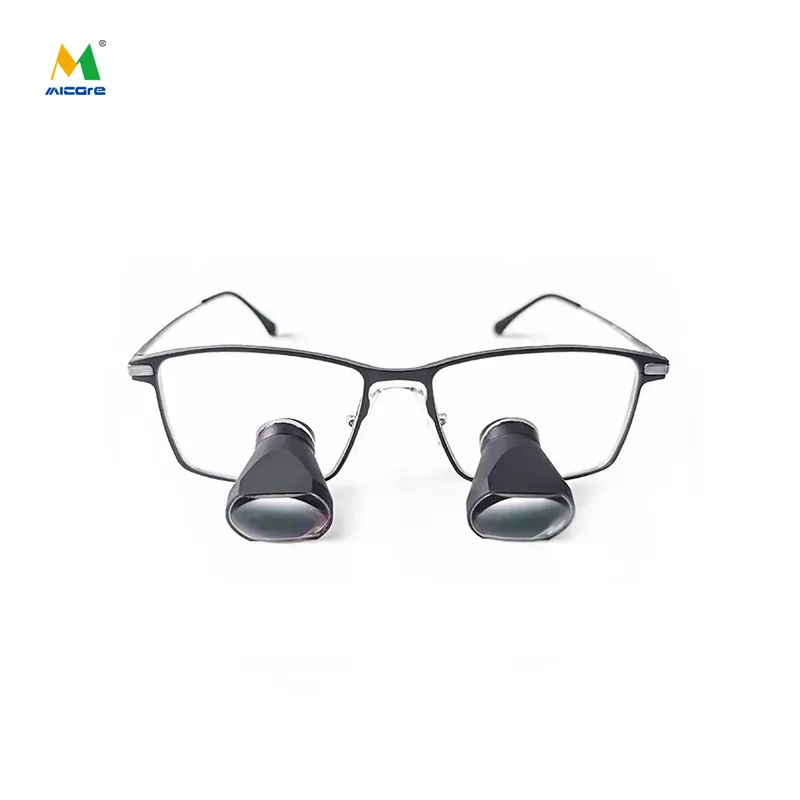
Loupes are essential to surgical accuracy in the medical field and not every loupe is alike. Two popular styles, TTL (Through-The-Lens) loupes and flip-up models differ vastly in both design and use considering the suitability to a task in the clinical setting. The awareness of the existing differences would assist clinicians when considering which tool is to be used in their workflow, which would be most comfortable and accurate in the long processes.
Design and Integration
TTL loupes are designed as an inseparable component of the frames, and the magnifying lenses are constructed into the optical window of the eyeglasses. There is no hinge or attachment, and that contributes to a low profile, clean design. which have the lenses inserted at an optimal angle fit to the line of sight of the user. The integration furthermore makes the loupes feel part of the vision of the wearer thus minimizing visual disorientation.
In comparison, flip-up models do not feature such high power magnification lens mounted on hinges, and do not attach to the frame. A pair of these lenses may be rotated up and out of the field of view when not being used and are easily flipped back down providing a versatile and popular choice among clinicians that alternate between high levels of magnification and normal vision. Although they are functional, the hinges are bulky and movement of the lenses can sometimes be slightly shifted around during use thus can only be rectified occasionally.
Weight and Comfort
The TTL loupes focus more on the long-term comfort by allowing the distribution of weight. Lenses are embedded in the frame reducing the weight to balance evenly on the nose and the temples with less pressure appeal.
The flip-up has hinge assembly parts and can be separated and thus generally heavier. The additional weight may be fatiguing after long use because the hinges and their joints focus the pressure on particular sections of the frame. It suits them to short procedures, in which flipping is more significant than a whole day of comfort.
Optical Performance
The TTL loupes are superior in terms of optical consistency, since they are fixed in terms of alignment. Lenses are set to interpupillary distance and working distance of the person using them during the manufacturing process hence free of distortion and with high field of view.
Although adjustable, flip-up loupes eventually experience some slight optical mismatch when used repeatedly in different positions because it flips. They are subject to calibration, but the moving parts also bring the risk of small adjustments to focus-something which is not present in the fixed design of TTL.
Suitability for Specific Procedures
TTL loupes can be suited to those situations that need prolonged magnification like microsurgery or complicated dentistry. Their stable position guarantees the use of the same visualization avoiding strains on the eye taking a long time to concentrate on the small structures. The simplistic design even combines with the headlamps.
The types favored on an alternating magnified and normal sight task are flip-up models e.g. general examinations or fast procedures. They can be flipped up so that clinicians can communicate with patients or consult charts without taking out the loupes which saves time in hectic environments.
To put it all in a nutshell, TTL and flip-up loupes serve different audiences: TTL can be used comfortably and will give high optical stability in very rigorous and long-term work, whereas flip-up models would be more versatile and apply to a variety of tasks. We have both types covered so clinicians should get exactly what fits in their practice.